Construction
Contract requirements, bonding capacity, subcontractor risk, and the moving jobsite exposures that don't fit a standard application.
Learn More◇06 — Industries We Serve
Every industry faces different risks, contractual obligations, and operational challenges. Our approach begins with understanding how your business actually operates.
◇ Our Approach
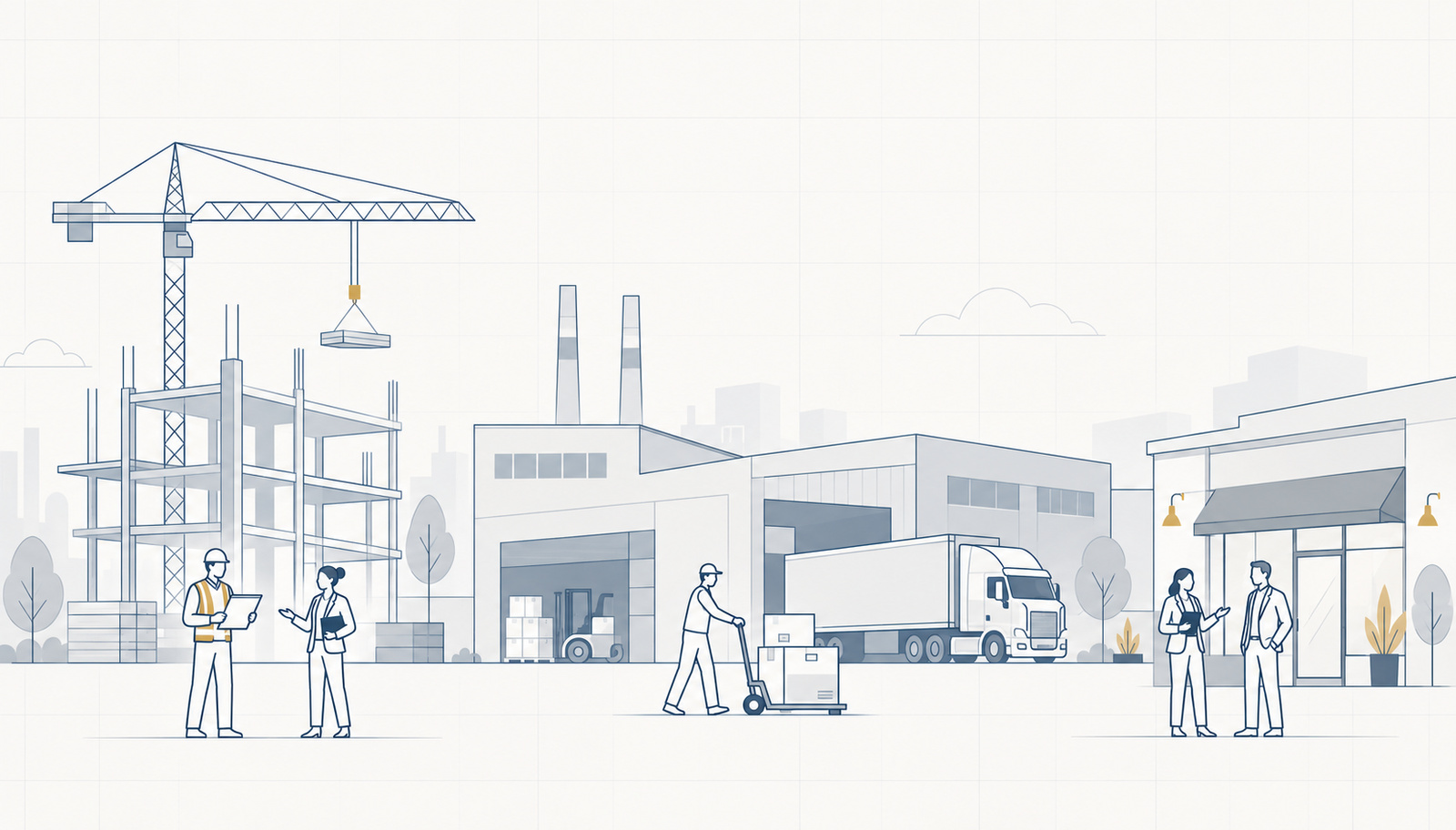
The policy forms available to any broker are largely the same. What differs — dramatically — is how each industry generates risk, what its contracts require, and how its programs need to be structured to respond correctly when a loss occurs.
Our role is to understand a client’s operations first, then design an insurance and risk strategy that supports those operations. The program follows the business — not the other way around.
◇ Industry Grid
Contract requirements, bonding capacity, subcontractor risk, and the moving jobsite exposures that don't fit a standard application.
Learn MoreProperty valuation, equipment breakdown, product liability, and business interruption sized to how the plant actually runs.
Learn MoreFleet placement, cargo, driver qualification, and DOT considerations across regional and interstate operations.
Learn MoreProperty values, tenant requirements, umbrella limits, and the loss control that keeps buildings insurable long-term.
Learn MorePortfolio programs, certificate management, and coordinated coverage across owners, managers, and tenants.
Learn MoreProfessional liability, cyber, employment practices, and the exposures firms rarely see until a claim.
Learn MoreProperty, general liability, product liability, and the seasonal and inventory exposures behind day-to-day operations.
Learn MoreLiquor liability, assault and battery, employment practices, and property programs built for high-traffic environments.
Learn MoreProfessional liability, cyber, regulatory exposure, and the coordinated coverage that clinical and administrative operations require.
Learn MoreDirectors and officers, volunteer exposures, employment practices, and program-specific liability for mission-driven organizations.
Learn MoreTech E&O, cyber, intellectual property, and coverage designed for how modern software and hardware companies actually operate.
Learn MorePollution, contractors' equipment, and specialized liability for operations working in and around energy infrastructure.
Learn MoreProperty, inland marine, cargo, and business interruption for operations where inventory movement is the business.
Learn MoreCoverage built around trade, project mix, contract obligations, and the growth path from small crews to prime contracts.
Learn MoreBuilder's risk, wrap-ups, professional liability, and the layered programs that complex development projects require.
Learn More◇ Featured Industries
◇ Sector 01
We work with general contractors, subcontractors, and developers whose insurance and bonding programs need to keep pace with the work — new contracts, new equipment, new crews, and new geographies. Our team reviews contract language, coordinates bonding capacity with underwriters, and builds programs that grow with the business.
◇ Sector 02
Manufacturers face a mix of property, machinery, product, and interruption exposures that rarely respond well to off-the-shelf coverage. We work through valuations, equipment breakdown, supply-chain dependencies, and the product liability programs that fit how goods are actually made and distributed.
◇ Sector 03
Fleets — regional, interstate, mixed-use — need coverage placed by underwriters who understand the operation. We work through driver qualification, MVR standards, cargo, telematics, and DOT considerations, and we help owners think about how a fleet's structure and growth affect long-term insurability.
◇ Sector 04
Law firms, accounting practices, consultancies, engineering firms, and other professional services organizations depend on tightly written coverage. We work through professional liability programs, cyber and privacy exposures, and the operational continuity planning that keeps client work moving.
◇ How We Learn Your Business
Step 01
We begin with conversation — how the business is structured, what it does, and where it's headed over the next few years.
Step 02
We look at the work itself — jobsites, facilities, fleets, contracts, and the exposures they create in practice, not just on paper.
Step 03
We map the operational, contractual, financial, and liability exposures that matter most to the business as it operates today.
Step 04
We compare the current program against the exposure map — what responds, what doesn't, and where the meaningful gaps sit.
Step 05
We recommend coverage, contract language, and process changes — with the reasoning behind each recommendation clearly explained.
Step 06
We stay engaged as the business changes — new locations, new services, new contracts — and adjust the program as it evolves.
◇ Related Services
Contract, license, and permit bonds — with underwriting relationships that grow with the business.
ExploreProperty, liability, workers' compensation, and specialty programs coordinated as one strategy.
ExploreSpecialized protection for high-value homes, excess liability, and complex personal assets.
ExploreStructured assessments, contract review, and long-term risk planning beyond the policy itself.
ExploreA named advisor from first notice through resolution — and through the post-claim review after.
Explore◇ Working Together
The exposures that matter most rarely appear on an application. They come out of a conversation about how the business actually runs — the crews, the contracts, the equipment, and the customers.
Insurance and indemnity language inside customer, vendor, and lease agreements routinely commits organizations to obligations they can't meet. We read that language before signing, not after a claim.
New locations, new services, new geographies, acquisitions — each of these is a business decision with an insurance dimension. We're the call before the decision, not after.
Most of our clients carry a program of related policies. We make sure property, liability, auto, workers' compensation, umbrella, and specialty lines respond as one system rather than a set of parts.
As industries change — cyber, supply chain, regulatory, workforce — we bring the exposures we're seeing across our book to your attention before they become claims for you.
Renewal is one touchpoint in the year. The rest of the calendar is where the meaningful work happens — reviews, contracts, growth conversations, and the questions worth calling us about.
◇ Common Questions
Don’t see your industry? We probably still work with organizations like yours — ask us.
Contact Our TeamTell us about your business, your growth plans, and the exposures that are on your mind. A first conversation is unhurried, practical, and useful — with candid guidance whether or not we end up placing the program.